In brief: Alternate big/small fish signal around group; same signal reverse cycle.
Intensity: Low
Introduction: This is an add-on to the “Did, Did Not” game. This game is useful in illustrating that all of us are so well-conditioned to the concepts of ‘big’ and ‘small’ that when these associations are changed, some of us will have difficulty adapting. It also shows that change gives rise to discomfort.
Prop(s): None
How to play:
- Participants stand/sit in a circle.
- Explain the actions and the accompanying phrases.
- “Big fish” – indicated by placing hands about four inches (10cm) apart, palms facing each other.
- “Small fish” – indicated by placing hands one foot (30cm) apart, palms facing each other.
- (Yes, the actions are opposite to the phrases – see picture)
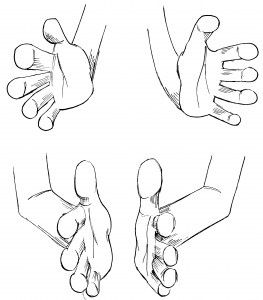
- Start the game by calling out, “Big fish” or “Small fish” and doing its corresponding (opposite) action.
- If the next person performs the opposite action, the impulse is passed along (e.g. if A says, “Big fish”, B says, “Small fish” and C says, “Big fish”, the impulse is passed in the direction A – B – C – D, where D is the next person in the circle)
- If, however, the next person performs the same action, the direction of the impulse is reversed (e.g. if A says, “Big fish”, B says, “Small fish” and C says, “Small fish”, the impulse is passed in the direction A – B – C – B).
- The game continues until someone makes a mistake.
- Note: set the rule that the signal cannot be passed back more than once to avoid the situation where the signal is stuck between two players.
- Mistakes are:
- When a player mixes up the phrases and the action.
- When a player does not pronounce the phrase properly (e.g. “Fig fish”)
- When a player takes more than 1 second for his/her turn.
